Serving all victims
Culturally specific and underserved population related language in the Violence Against Women Act

I have spoken to some people in the victim services world who were concerned about providing culturally specific services and population specific services under the current administration given the conditions and prohibitions against diversity, equity, and inclusivity (DEI) and the conditions and orders related to immigrants. One of my prior articles talked about some of the court cases and injunctions addressing these conditions. With this article, I want to focus on the statutory framework of VAWA that provides for culturally specific and population specific services as well as provisions that focus on culturally specific and underserved populations.
I want to draw your attention to language in OVW’s recent Notices of Funding Opportunity (NOFOs) stating that “recipients should serve all eligible victims as required by statute, regulation, or award condition.” This article will discuss the statutory language in each OVW program relating to culturally specific and underserved populations, including mentions of eligible victims and types of services (such as population specific services).
Note: I am not including the Culturally Specific Services and Underserved Victims Programs because they are 100 percent dedicated to culturally specific and underserved populations (respectively) and I will do a deeper dive on these in my next article. Also, my colleagues over the years at OVW educated me on the fact that Tribal funding and the status of Tribes as sovereign nations is legally different than “culturally specific” and that is why I am not calling out provisions specific to Tribes in this article, but I plan to focus a future article exclusively on Tribal funding.
Note: a couple of the cases discussed in the previous articles have had new injunctions issued, both pertaining to The Office for Victims of Crime (OVC). See Freedom Network USA v. Trump and Rhode Island Coalition Against Domestic Violence v. Todd Blanche.
Statutory language re: culturally specific/underserved.
Following is the list of OVW programs with language relating to culturally specific or underserved populations. See https://www.justice.gov/ovw/funding-opportunities for more information on each program.
First a few notes on terminology used in the list. When I talk about “purpose areas” below, this means that it is one of the allowable uses for funds under the program. When a statute states that DOJ shall “give priority,” the NOFO will provide information on how the priority is given. For example, the 2025 Abuse in Later Life NOFO specifies that to adhere to the statutory requirement to give priority to proposals providing services to culturally specific and underserved populations, “OVW will give special consideration to applicants proposing to meaningfully increase access to services for underserved and culturally specific populations. Therefore, applicants should provide information about whether their projects provide services to culturally specific populations. (Note that special consideration does not mean that applicants will receive any additional points for their responses during peer review or programmatic review).”
Abby Honold:
Focus: providing trauma-informed, victim-centered training for law enforcement.
One of the purpose areas is for “customizing investigative approaches to ensure a culturally and linguistically appropriate approach to the community being served.”
Abuse in Later Life:
Focus: training and services addressing victims in later life.
Statute includes a requirement for OVW, specifying: “In making a grant under this section, the Attorney General shall give priority to proposals providing services to culturally specific and underserved populations.”
Campus:
Focus: improving responses of colleges and universities to domestic violence, dating violence, sexual assault, and stalking (hereinater “the VAWA crimes”).
The statute specifies: “The Attorney General shall make every effort to ensure …(C) the equitable distribution of grants under this section to tribal colleges and universities and traditionally Black colleges and universities.” In addition to this, appropriations in Fiscal Year(FY) 2022-2026 included a specific set aside ($12,500,000 in FY 2026) for grants to Historically Black Colleges and Universities, Hispanic-Serving Institutions, and Tribal colleges and universities.
Several purpose areas make relevant references:
To provide prevention and education programming … that is age-appropriate, culturally relevant…
To develop, enlarge, or strengthen victim services programs and population specific services on the campuses of the institutions involved…
To create, disseminate, or otherwise provide assistance and information about victims’ options on and off campus to bring disciplinary or other legal action, including assistance to victims in immigration matters.
To develop or adapt, provide, and disseminate developmental, culturally appropriate, and linguistically accessible print or electronic materials to address both prevention and intervention…
To develop or adapt and disseminate population specific strategies and projects for victims of [the VAWA crimes] from underserved populations on campus.
Cybercrimes Resource Center:
Purpose: to establish and maintain a National Resource Center on Cybercrimes Against Individuals.
The recipient must maintain a resource library including information on the provision of services and resources for victims of cybercrimes against individuals, including victims from underserved populations.
Note: there is also a Cybercrimes grant program for local law enforcement grants, but the statute does not include any references to culturally specific or underserved populations.
Disabilities Program:
Purpose: to provide training, consultation, and information on the VAWA crimes and abuse by caregivers against individuals with disabilities and Deaf people and enhance direct services to such individuals.
The statute specifies: “in awarding grants under this section, the Director shall ensure that the needs of underserved populations are being addressed.”
Electronic Service Protection Order Court Pilot Program (ESPOC):
Purpose: to develop and implement programs to properly and legally serve protection orders through electronic means.
Required partners include a provider of culturally specific services.
The statute also provides a list of types of courts to fund to the extent practicable that includes “a court that primarily serves a culturally specific and underserved population.”
Improving Criminal Justice Responses (ICJR):
Purpose: to improve the criminal justice response to victims of the VAWA crimes and seek safety and autonomy for victims.
Purpose areas:
legal advocacy/assistance and victim services, “including strengthening assistance to such victims in immigration matters”
policies, protocols, and training for law enforcement, prosecutors, and the judiciary in addressing VAWA crimes against immigrant victims, including appropriate use of T and U visas.
policies, protocols, and training for law enforcement on sexual assault and treatment of victims, “including victims among underserved populations.”
Applications must include documentation from victim service providers and, as appropriate, population specific organizations demonstrating participation.
Justice for Families:
Purpose: to improve the response of the civil and criminal justice system to families with a history of the VAWA crimes, or in cases involving allegations of child sexual abuse.
Statute specifies that any services provided pursuant to a grant under this program “shall be provided in a culturally relevant manner.”
Legal Assistance for Victims (LAV):
Purpose: to increase the availability of legal assistance to victims of the VAWA crimes who are seeking relief in legal matters relating to or arising out of the abuse or violence.
Applicants must certify certain things, including demonstrated expertise of the applicant or partner and training if the expertise comes from a partner. Such training must be developed with input from a state, territorial, tribal, local or culturally specific victim service provider or coalition.
LGBT Specific Services:
Purpose: to enhance lesbian, gay, bisexual, and transgender (LGBT) specific services for victims of the VAWA crimes.
Purpose area: “supporting programs that specifically address underserved LGBT communities, including culturally specific communities, to provide specific resources and support for LGBT underserved victims” of VAWA crimes.
Restorative Practices:
Purpose: to support the development and assessment of restorative practices to prevent or address the VAWA crimes, as well as related training and technical assistance.
The statute requires OVW to give priority to eligible entities that submit proposals that “meaningfully address the needs of culturally specific or underserved populations.”
Rural:
Purpose: to carry out programs in rural areas that address the VAWA crimes.
One strategy in the program statute is to provide “treatment, counseling, advocacy, legal assistance, and other long-term and short-term victim and population specific services…, including assistance in immigration matters.”
OVW is required to “give priority to the needs of underserved populations.”
Sexual Assault Forensic Exam Program:
Purpose: to increase the access to trained Sexual Assault Nurse Examiners (SANEs) and Sexual Assault Forensic Examiners (SAFEs).
Statutory priority for applicants that partner with a rape crisis center or state coalition to provide services and will use funds to … “increase…availability of …[SANEs] in a rural area, Tribal area…, or for an underserved population, including efforts to provide culturally competent services.
Sexual Assault Services Program (SASP):
Includes a formula grant to states and territories for sexual assault services, discretionary programs for Tribal sexual assault services and culturally specific sexual assault services, as well as funding for state and Tribal sexual assault coalitions.
The formula program and the Tribal and culturally-specific programs support “Intervention and related assistance” which includes “community-based, culturally specific services and support mechanisms, including outreach activities for underserved communities.”
For the formula program, applications must “set forth procedures designed to ensure meaningful involvement of… representatives from underserved communities in the development of the application and the implementation of the plans.”
STOP Violence Against Women Formula Grant Program:
Formula grant to states and territories improve criminal justice response to the VAWA crimes and enhance victims services.
Purpose areas:
victim services and legal assistance including to underserved populations
assistance to victims in immigration matters
Services for victims “whose ability to access traditional services and responses is affected by their sexual orientation or gender identity”
improving evidence collection, including technology that “better detects bruising and injuries across skin tones”
Applicants must develop an implementation plan in consultation with a list of entities that includes representatives from underserved populations including culturally specific populations and population specific organizations. The plan must include “a description of how the state will meet the needs of underserved populations, including the minimum allocation for population specific services”
States must allocate 30 percent of funds for victim services of which al least 10 percent “shall be distributed to culturally specific community-based organizations.”
Transitional Housing:
Purpose: to provide transitional housing, short term housing assistance, and support services to enable a victim of the VAWA crimes to locate and secure permanent housing, secure employment, and integrate into a community.
Statutory priority for projects that “primarily serve underserved populations.”
Workplace Resource Center:
Purpose to establish and operate of a national resource center on workplace responses to assist victims of domestic and sexual violence and sexual harassment.
Applications must include a plan to develop materials and training on the needs of employees in cases of the VAWA crimes or sexual harassment impacting the workplace “including the needs of underserved populations.”
Statute includes a “Pathways to opportunities pilot” which shall be “centered around culturally specific organizations or organizations that primarily serve populations traditionally marginalized in the workplace.”
Note: some programs, such as Consolidated Youth are created by appropriation and therefore don’t have statutory provisions such as purpose areas.
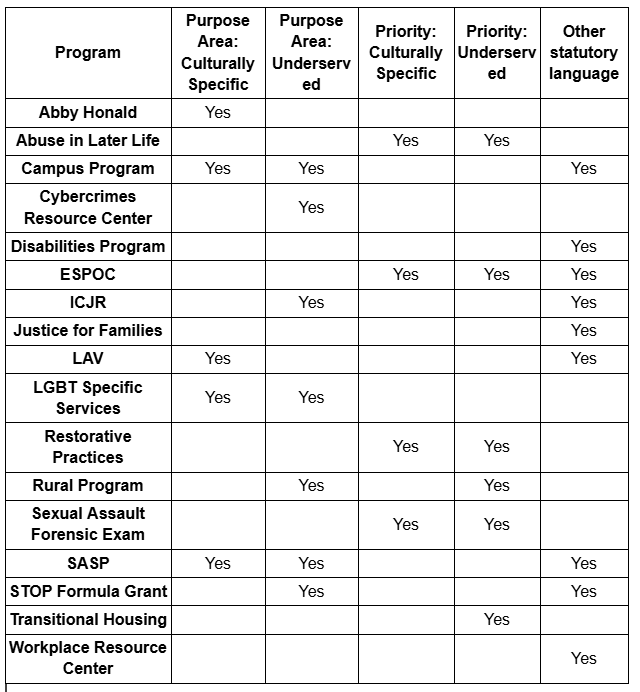
The following table illustrates which programs have purpose areas, priorities, and other language relating to culturally specific or underserved populations: