Why OVW should be a separate office
DOJ’s illegal proposal to merge grant offices

Introduction:
The Department of Justice (DOJ) has recently proposed consolidating the Office on Violence Against Women (OVW) into a larger, generalized grant-making entity—the Bureau of Justice Grants (BJG). While the DOJ claims this merger will cut costs and improve administrative efficiency, a historical, statutory, and financial analysis reveals that the proposal would introduce counterproductive bureaucratic red tape, dilute specialized leadership, and potentially compromise victim safety. To safeguard the nation’s coordinated response to gender-based violence, OVW must remain a standalone, independent component within DOJ whose Director reports directly to the Associate Attorney General.
Historical Context and Statutory Mandate:
The Violence Against Women Act (VAWA), enacted as landmark legislation in 1994, fundamentally transformed how our legal and social systems address domestic violence, sexual assault, dating violence, and stalking. Initially, DOJ implemented its statutory responsibilities under VAWA through two separate offices: a policy-focused Violence Against Women Office (VAWO), which was housed within the Attorney General’s Office, and a grant-focused Violence Against Women Grant Office (VAWGO), which was housed within DOJ’s Office of Justice Programs (OJP). In 1999, these offices were merged under OJP. I started working at OVW in 2001.
In November 2002, Congress enacted the Violence Against Women Office Act, Title IV of Public Law 107-273 (VAWO Act), codified as amended at 34 U.S.C. §§ 10442-10445, which formally established OVW as a “separate and distinct office” within DOJ and set forth the responsibilities of its Director. To comply with this statutory mandate, DOJ formally separated OVW from OJP in January 2004, establishing it as an independent component whose Senate-confirmed Director reported to the Associate Attorney General. Over time, OVW increased its capacity to operate independently by, for example, adding its own Grants Financial Management Division and General Counsel. This means that people working with OVW’s grant programs have specific expertise on VAWA and on gender-based violence. At the same time, OVW continued to achieve efficiencies for itself and its grantees by contracting with other DOJ entities for certain services and collaborating with other DOJ grantmaking offices.
Although DOJ complied with the VAWO Act’s directives, DOJ maintained following its enactment that it retained the authority to house OVW within another component. In addition, in the years since the VAWO Act, some critics have urged that OVW be consolidated into a larger grantmaking entity. To leave no room for administrative reinterpretation, Congress amended the VAWO Act in the VAWA Reauthorization Act of 2022, explicitly mandating that OVW:
“...shall be a separate and distinct office within the Department of Justice, not subsumed by any other office...”
Furthermore, the law explicitly grants the Presidentially appointed, Senate-confirmed OVW Director “final authority over all grants, cooperative agreements, and contracts awarded by the Office” (34 U.S.C. § 10442). Subsuming OVW under a broader grant-making bureau directly violates both the letter and the intent of this federal law.
Broad Policy Leadership and Federal Coordination:
OVW is not merely a grantmaking office; it is the federal government’s primary policy leader on gender-based violence. Its independent stature ensures that it has the gravitas and access to coordinate directly with top DOJ leadership and other federal agencies, driving a unified national response. The statute spells out the role of the Director, which includes:
Maintaining liaison with the judicial branches of the Federal and State Governments on matters relating to violence against women.
Providing information to the President, the Congress, the judiciary, State, local, and tribal governments, and the general public on matters relating to violence against women.
Serving, at the request of the Attorney General, as the representative of the Department of Justice on domestic task forces, committees, or commissions addressing policy or issues relating to violence against women.
Providing technical assistance, coordination, and support to—other components of the Department of Justice, in efforts to develop policy and to enforce Federal laws relating to violence against women, including the litigation of civil and criminal actions relating to enforcing such laws; and other Federal, State, local, and tribal agencies, in efforts to develop policy, provide technical assistance, synchronize Federal definitions and protocols, and improve coordination among agencies carrying out efforts to eliminate violence against women, including Indian or indigenous women.
Over the past two decades, OVW’s independence and stature within DOJ has enabled OVW to spearhead highly specialized, interdisciplinary initiatives that a generalized grantmaking office could not effectively replicate. Some examples include:
The National Protocol for Sexual Abuse Forensic Examinations- Pediatric: We consulted with numerous experts on child abuse, victim advocacy, medical care, law enforcement, prosecution, etc. This included both experts external to the government and internal (such as the Federal Bureau of Investigation and Indian Health Services). The final product was approved by the Attorney General before issuing.
Collaborations on the intersection of domestic violence and firearms: As an independent entity, OVW staff can collaborate directly with agencies like the Bureau of Alcohol, Tobacco, and Firearms (ATF) and Federal Bureau of Investigation (FBI) to address critical safety intersections, such as the nexus between domestic violence and firearms. It enabled us to work with other agencies to develop this resource page and this reference card.
DOJ Framework for Prosecutors to Strengthen Our National Response to Sexual Assault and Domestic Violence Involving Adult Victims: This document provides a blueprint for building provable cases in a trauma-informed manner that treats victims with humanity and ensures due process for defendants. It sets out five practical principles that, if implemented, will lead to better outcomes for victims, safer communities, and greater accountability for perpetrators of gender-based violence. It is a consensus document of more than 120 state, Tribal, federal, and Military prosecutors and other law enforcement experts from throughout the country.
This slide, provided by DOJ, shows the planned structure of the new office.
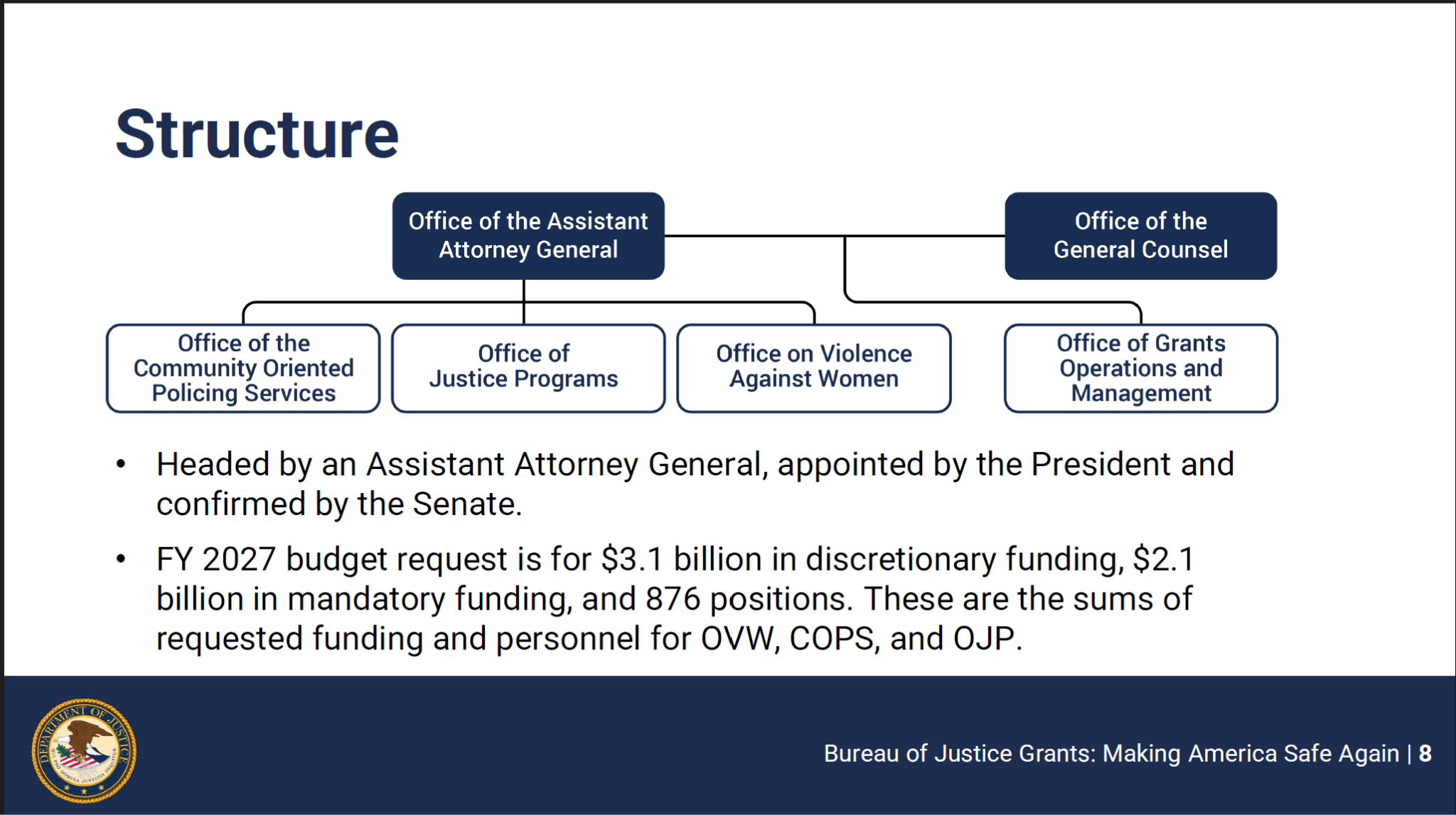
OJP already reports through an Assistant Attorney General, but this would add a layer of unnecessary bureaucracy for OVW that would hinder its ability to perform the broader policy-based functions described above.
Debunking the Efficiency Myth: A Financial Analysis
DOJ asserts that merging grant offices increases efficiency and lowers operational costs. An analysis of the President’s Budget request, however, reveals that OVW is already an exceptionally lean, cost-effective office compared to OJP.
Management and Administration (M&A) expenses are not separately appropriated; they are deducted “off the top” of grant funds, meaning higher overhead directly takes life-saving resources away from local communities. A side-by-side comparison (based on an analysis of the 2026 and 2027 President’s Budget requests) reveals that OJP operates with more than double the administrative overhead percentage of OVW:
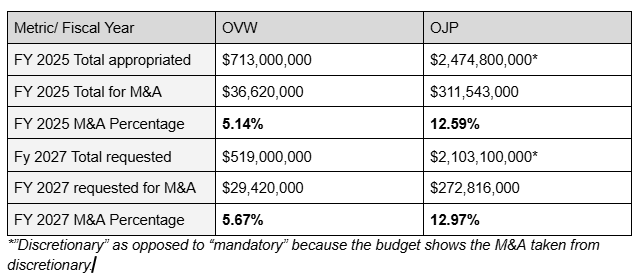
This also illustrates that, based on the Administration’s own request, the percentage of funds appropriated for grants that is dedicated to overhead will increase with the merger, rather than decrease.
Negative Impact on Tribal Sovereignty
A merger would also degrade the critical government-to-government relationship that federal agencies are legally mandated to maintain with Tribal Nations.
Title IX of VAWA 2005, the Safety for Indian Women Act, explicitly codified Tribal engagement by establishing a Deputy Director for Tribal Affairs at OVW and mandating an annual Tribal consultation. Lowering OVW’s organizational status introduces bureaucracy that could delay consultations and slow funding. As the Sovereign Tribal Leaders of the National Congress of American Indians Task Force on Violence Against Women noted at the 2025 OVW Tribal Consultation:
OVW must remain a separate and distinct office within DOJ, as mandated by federal statute. The office’s specialized subject matter expertise and institutional knowledge are vital for maintaining federal investment in addressing domestic and sexual violence. Consolidating the OVW with other departments would likely weaken the enforcement of the VAWA and jeopardize the victim-centered services that are critical for the safety of Indigenous women. Any such structural change would legally require statutory amendments by Congress and extensive Tribal consultation.
Conclusion and Call to Action
The proposed consolidation violates clear federal statutory directives, dilutes the specialized focus required to lead the federal government’s efforts to combat domestic and sexual violence, and does not create cost savings.
How You Can Take Action:
Submit Comments: Voice your opposition directly to the Department of Justice by emailing BJG.Feedback@usdoj.gov.
Contact Your Congressional Representatives: Call or write (including by just copying them on your comments to DOJ) your Senators and House Representatives. Urge them to oppose this illegal restructuring and protect OVW’s statutory independence. You can find your local members of Congress using the Congress.gov Directory.
Talking points for your comments:
Start with who you are and your relation to OVW. For example, have you received a grant from OVW? Were you a recipient of OVW funded services or training and technical assistance? Have you used OVW products such as the National Protocol for Sexual Assault Medical Forensic Examinations?
Talk about any experience you have with OVW.
Talk about how Congress recognized the uniqueness of crimes of violence against women in passing the VAWA and the Violence Against Women Office Act described above and mandated that OVW must be a “separate and distinct office within the Department of Justice, not subsumed by any other office” and that the OVW Director must “have final authority over all grants, cooperative agreements, and contracts awarded by the Office.” Any merger of OVW and the addition of an Assistant Attorney General above the OVW Director would violate these provisions.
Address the importance of having grant program specialists, grants financial analysts, attorneys, and other federal staff who have expertise regarding domestic violence, dating violence, sexual assault, and stalking make award recommendations, review grant budgets, oversee grants, and prepare policy recommendations.
Discuss how reporting directly to the Associate Attorney General enables the OVW Director to ensure that the concerns of victims and survivors are considered at the highest level of DOJ.
Emphasize that, based on the President’s budget proposal, merging OVW into a consolidated DOJ grantmaking component will not create any cost effectiveness and the efficiencies discussed in the President’s Budget request (such as consistent NOFO templates and award processes) can be (and have been) done without merger.